
Billerica Previous Residents Sources
Past residents are best traced as a dated chain of separate evidence. Recorded land identifies transfers and legal descriptions. A current assessment card can provide a recent map-lot and owner display. The library preserves local street lists, voter-registration lists, directories, newspapers, yearbooks, maps, cemetery catalogs, and town documents. Historic-map material can describe the built site, but it does not establish who was there. Begin with a source whose date fits the period in question, then record what it actually proves.
| Source | Years It Covers | Where Held | What It Shows |
|---|---|---|---|
| Middlesex North recorded land | Records begin 1629 | Registry, online tools, microfilm, and counter | Transfers, parties, legal descriptions, plans, and title references. |
| Computerized deed index | 1966 to present | MassLandRecords Middlesex North | Searchable recorded-land and historical index pathways. |
| Scanned deed images | About 1995 to present | Registry system | Images for following a cited instrument and its prior-title reference. |
| Local History Room materials | Varies by title and collection | Billerica Public Library | Street lists, directories, maps, newspapers, yearbooks, and town records. |
| Lowell/Billerica Sanborn sheet | 1907, republished 1952 | Library of Congress | Built-site and place context, not a list of people at an address. |
For earlier registry work, older indexes and books are reached through the unindexed and pre-1976 tools, microfilm, public terminals, or in-person assistance. A blank online query is not a final answer when the relevant record may be in a book, a plan, a library collection, or an archived court file.
Billerica Past Households Start With a Reference
Use the current address only as the beginning of a backward file. Record the street address as printed, the parcel map-lot, an owner or grantee name, the instrument type, recording date, book and page or certificate, any plan reference, and the next link to chase. The Billerica assessment portal can provide municipal assessment information, but research did not capture its exact current fields. Check the live display before relying on a parcel detail.
Assessment, map, and deed evidence should remain separate. The assessor card is a recent tax and parcel reference. A GIS or assessor map helps orient a map-lot and adjoining parcels, but it is not a survey or conveyance instrument. The recorded deed carries the legal description and the transaction parties. A present owner also may not answer who lived at the address during the date being studied.
Note: Preserve the source date beside every address form, map-lot, and name variant so a later search can distinguish a changed record from a changed conclusion.
Billerica Previous Residents and the Deed Chain
The Middlesex North recorded-land search is the core title route for Billerica. Its basic name search supports a last or business name, first name, middle name, party type, document type, town, and recorded-date range. It also offers recorded-land, registered-land, plan, unindexed, and pre-1976 pathways. A current deed's title reference normally points to the earlier conveyance. When it does not, the seller's name becomes the next key.
- Use the recent assessment or deed reference to identify the parcel, current owner or grantee, and recorded instrument.
- Open the deed and copy its recording date, book and page or certificate, legal description, plan citation, and stated prior-title reference.
- Follow the title reference to the previous conveyance. If there is no usable reference, search the seller as a grantee, using name variants and a sensible date window.
- Repeat the transaction log backward, separating a conventional conveyance from an executor deed, deed of distribution, plan, or registered-land certificate.
- When the online path ends, move to the Registry's historical tools, microfilm, public counter, or assistance rather than assuming the chain has ended.
- Grantor
- The party transferring an interest in a recorded instrument.
- Grantee
- The party receiving the interest. A prior seller may be found as grantee on an earlier purchase.
- Chain of title
- The sequence of recorded links used to trace an interest in land from one instrument to an earlier one.
- Legal description
- The recorded land description, plan reference, or certificate language that is often more durable than a modern street address.
Registered land can require a certificate or Land Court reference instead of a simple book-and-page trail. A failed book-and-page search therefore does not prove that no Billerica title record exists. Record the search path and switch to the matching Registry pathway before treating an older link as missing.
Billerica Past Households Before Online Index
The Registry's physical record sequence explains a common gap in a house-history search. Handwritten books run through 1924, typewritten volumes cover roughly 1924 through 1949, microfilm prints cover roughly 1949 through 1995, and scans begin around 1995. Computerized indexes begin in 1966. That progression does not create a single clean cutoff. It means the search method changes as the record format changes.
Addresses were not consistently indexed until the late 1990s. For a nineteenth-century or early twentieth-century Billerica address, a street-only search can miss the evidence even when a deed exists. Start from a known owner, grantee, map-lot, legal description, plan, or town name. The Registry's genealogical research guidance documents this name-based approach.
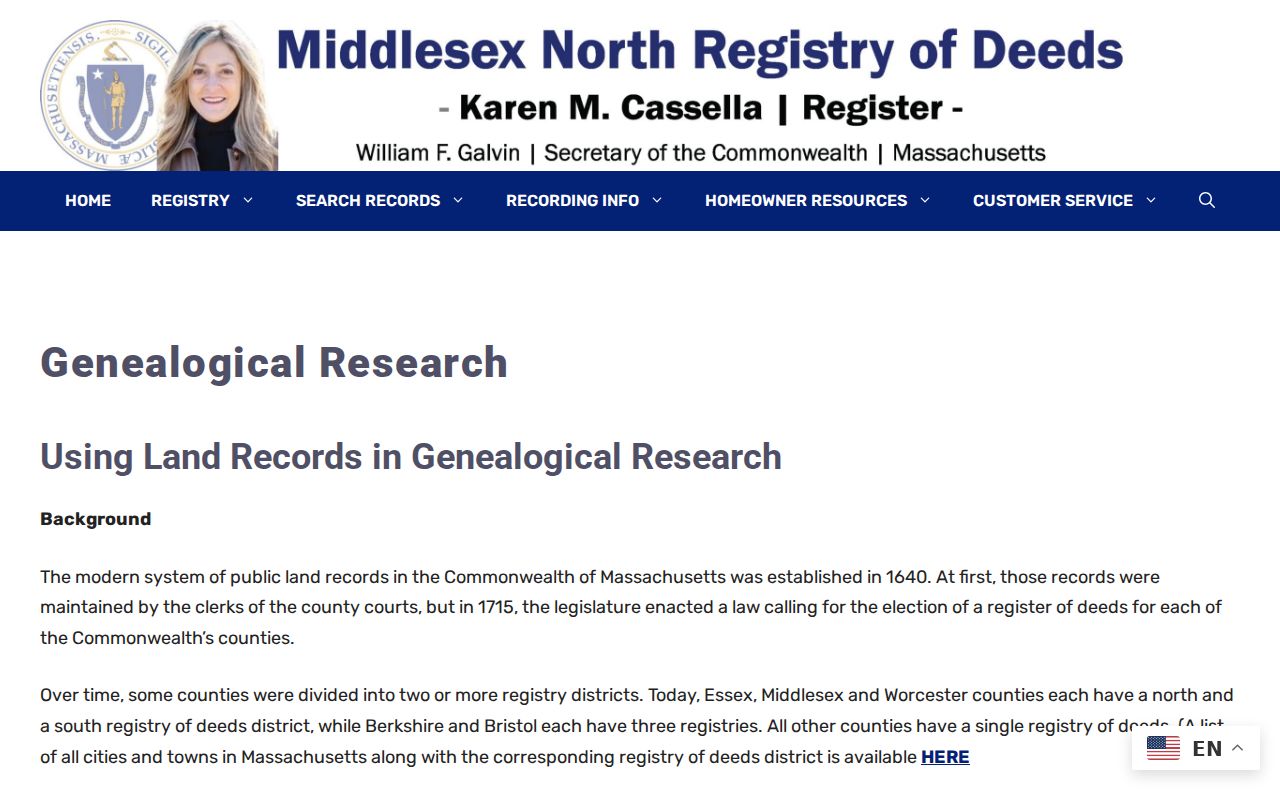
The Registry guidance illustrates why a title trail needs recorded names and references, not only the current street form.
Billerica Road Plans and Past Households
Road and subdivision history can explain why an address seems newer than the lot it occupies. The Registry's Billerica County Layout Plans page places the listed Billerica plans in Plan Book 910. It includes named layouts for Billerica Avenue, Boston Road, Brick Kiln, High Street, Lowell Street, Allen Road, and other roads, with plan dates ranging from the 1880s into the 1970s.
Start with the named plan when the address sits on one of those roads, then compare its date with the earliest deed link, directory year, assessor map, and historic map. A plan may explain a new road, changed frontage, or a parcel subdivision. It does not prove that a particular person lived there. No official source located in this research confirmed a town-wide Billerica street-renumbering event, so no such event should be assumed.
Billerica Directories and Past Households
Recorded title is only one layer of the past. To test who lived at a Billerica address during a particular period, pair a dated directory, street list, voter-registration list, newspaper, yearbook, or cemetery catalog with the deed chain. The Billerica Public Library Local History Room brings those formats together, and the library's local-history resources identify room materials, databases, and reference help. Exact directory coverage varies by title and publisher, so preserve the title page, year, page, town heading, and entry type.
- Choose the deed or plan date nearest the period being tested.
- Locate a Billerica directory, street list, phone book, or newspaper source close to that year and record the complete citation.
- Compare the name and address with the matching available census era, without filling a missing address from a modern map.
- Use a yearbook, cemetery catalog, obituary, annual report, or probate lead only for the limited fact it supports.
- Resolve conflicts with the most contemporaneous original or near-contemporaneous document, not with a modern assumption.
The collections themselves are described more fully in the Billerica city directory. On an address history, the useful question is narrower: does a dated household clue agree with the location and timeframe of the land record?
Billerica Address History and Built Context
The Library of Congress Lowell/Billerica Sanborn sheet is a 1907 map republished in 1952 and names Billerica Center, Forge Village, and North Billerica among the places shown. It can clarify the built setting of a road, mill area, rail corridor, or block. It cannot identify a household, prove a person's address, or replace an ownership record. Use it alongside the date on a directory or deed rather than treating the map as a resident roll.
A captured view of the Billerica Historic Preservation resources shows the town's historic-home research route.
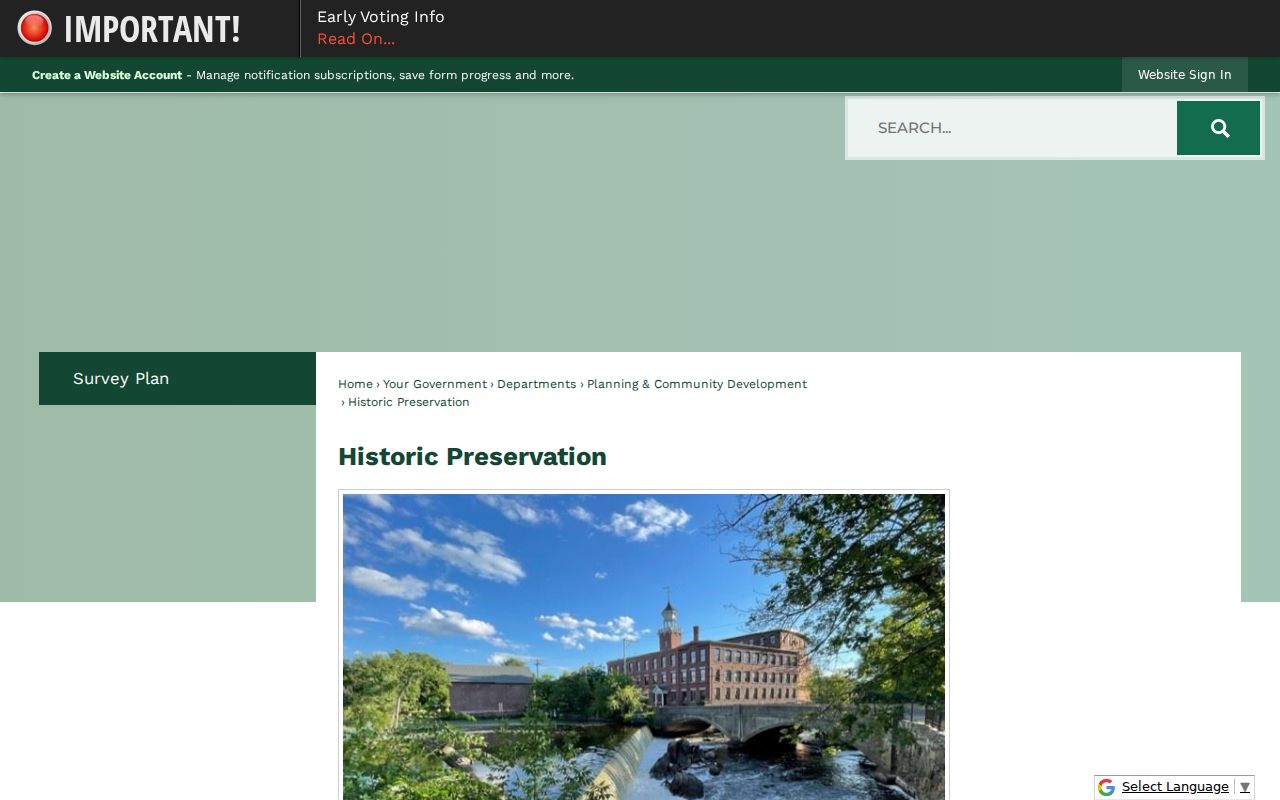
The historic inventory and MACRIS leads can supply construction-era context or an older house name, but the research notes that many town inventory forms date from the 1970s and early 1980s and may need updating.
Billerica Library and Past Households
The Local History Room has an unusually useful mix for a backward address trail: town reports, street lists, voter-registration lists, yearbooks, phone books, newspapers, maps, cemetery catalogs, genealogies, and local government documents. Some material remains room-only. Rare items require an appointment with the Local History Librarian, microfilm-reader use is by appointment, and the room policy uses one item at a time with pencils. A blank web search therefore does not exhaust the collection.
The Massachusetts State Library genealogical guide expands the search to statewide directory, newspaper, and genealogy holdings. Its collections can help when Billerica's local shelf does not carry the needed title. Keep the source institution and the volume year in the research log because digital-collection platforms and links can change.
A captured State Library guide provides a useful route to the wider Massachusetts collection.
The state-level holdings complement local files, but they still require a title-by-title check rather than an assumption of a complete annual Billerica run.
Lawful Billerica House History
A responsible Billerica house history separates land memory, household clues, and current personal information. The Great Deed, preserved through Community Preservation funding in 2019, is a local example of historical land memory. It is meaningful history, yet it is not a shortcut to present title. For a current recorded question, return to the Registry instrument, cited plan, and assessor reference. For a historical household question, retain the year and source beside the claim.
Lawful use. Use Billerica previous-resident research for family history, estate or heir work, source verification, and property history. Do not use historical or current records to track, harass, intimidate, or defeat a protected address.
Probate may interrupt a deed chain through an estate, executor deed, or deed of distribution. That is a reason to check the appropriate court custodian and preserve the case reference, not a reason to infer relationships or a current location from a name. Treat every gap as a question about the record system first.